Showing posts with label Travel. Show all posts

Tuesday, June 24, 2008

Suffering from a Case of Delayed Trip Gratification

I’ve been back almost a month now. I’ve been holding off the itch to travel by reminiscing about my time in the Philippines, and now that I’m finally done with that exercise I fear that the itch is coming back.

Rene thinks I suffer from Delayed Trip Gratification (DTG) when it comes to traveling abroad. It doesn’t happen all the time but it does hit me now and again. DTG is when you are in a foreign place and all you can do that moment, that afternoon, that day is whine about something silly: how hot (or cold) it is, how it ruined your day that [blank] wasn’t being served for lunch, how rude that waiter was, how obnoxious all the tourists are (except you, hee), how you have to wait so long to get from point A to point B, yada yada the list goes on. Does that sound like something you do? Then after you get home all you can tell your family and friends is how wonderful that trip was, how you’d love to visit again, how the sights were marvelous, and how you wish you were still there. It’s almost downright schizophrenic, really, to switch from Whiny Wendy to Thankful Tammy once you get home. Then you regret letting all those petty worries take over you and beat yourself for not living in the moment. This has happened to me more than once.

All I can remember about my trips are the good times, and the bad times are either forgotten or romanticized. For example, Rene and I once took a boat launch from a small Australian town called Gladstone to Heron Island (in the Great Barrier Reef). That launch was rough – practically all of the passengers were out in the deck throwing up and praying for land. I took Dramamine an hour before and was doing fine; Rene, however, “wanted some air” (read: was feeling seasick) so we ended up hanging out in the rear deck, breathing in the acrid smell of vomit for a solid hour and a half. Now we affectionately call that vessel “the Barf Boat” and find it amusing that everyone was hanging off the side rail with a deathly green pallor.

I suppose DTG is better than the alternative – remembering only things that went wrong on the trip. Because honestly, who doesn’t want to cherish their travel memories, no matter how imperfect?

Monday, June 23, 2008

Pearl of the Orient

On my second-to-the-last day in the Philippines I scheduled a tour with the great Carlos Celdran of Celdran Tours. (If you are planning to visit Manila in the future, I highly recommend bookmarking his website.) His tours are among the best I’ve ever taken, and that says a lot coming from a person that LOVES tours, particularly walking tours and bike tours.

His tour, entitled Living La Vida Imelda! is an “architectural tour of the Cultural Center of the Philippines Complex as seen through the life and aspirations of Imelda Romualdez Marcos.” I was intrigued with the juxtaposition of architecture and Philippine history, not to mention the woman herself. Who could forget Imelda and her 3,000 pairs of shoes? This was the woman who famously said, after her family was exiled from the country, “They went into my closets looking for skeletons, but thank God, all they found were shoes, beautiful shoes.”

I’ve been intrigued by Imelda ever since I visited Malacanang Palace in the late 1980s. Malacanang Palace is the Philippine equivalent of the White House, and for a time it was open to the public for tours. I remember going with my mom, wearing my brand new white peep toe shoes, feeling sophisticated and grown up. I was astonished by the fact that a woman could own THAT MANY pairs of shoes (and with labels like Chanel, Ferragamo, Givenchy and Dior! A girl can only dream of owning such precious jewels!), and a light bulb went off in my head. I’ve never looked at shoes the same way again. Currently, my closet is home to about 30-something pairs of fine-looking shoes, shoes that I adore and treasure.

The Cultural Center of the Philippines (or CCP) is located in Manila, and opened its doors in 1969 to promote and preserve Filipino arts and culture. It opening was attended by then-California Senator Ronald Reagan and his wife Nancy, and has showcased the Bolshoi, Kirov, Royal Danish ballets, as well as contemporary American, French, German and Philippine companies. In its heyday, luminaries such as Marta Graham and Rudolph Nureyev posed alongside the former First Lady onstage.

It’s hard to imagine that such a promising young couple, Ferdinand and Imelda Marcos, would go down in history as one of the most corrupt leaders in the free world. In the beginning, the Marcoses were branded as the Philippines’ version of John and Jackie Kennedy. During his first term, Marcos made substantial land reforms, developed infrastructure, improved health care, and boosted the economy, leading others to see the Philippines as a country on the rise. Sadly, along with these improvements came human rights abuses, rampant corruption and embezzlement, and voter fraud. Marcos was finally thrown out as a result of the People Power Movement. I remember my parents participating in the and wearing lots of yellow at that time, the color of the movement. Marcos and his family were exiled to Hawaii in 1986, where he died three years later. The saddest part about Marcos, in many people’s eyes, was the great president he could have become.

In a way it was fitting that I ended my vacation with a tour like this. It reminded me of my heritage, my history, and how great this country was, is, and can become. Despite its many faults, it’s hard not to love your homeland, a country with unshakeable spirit and an abundance of natural beauty. I plan to visit again in the future, and have already created a list of must-see places that I didn’t experience this time around:

Mt. Mayon: This is one of the most photographed sights in the Philippines. In the shape of a perfect cylindrical cone, Mt. Mayon is one of the world’s most active volcanoes, erupting 14 times since 1900.


Banaue Rice Terraces: Natural landmark created by the Ifugao tribes nearly 2,000 years ago. The tribe created a sophisticated irrigation system using bamboo tubes and mud channels to bring water to the terraces. Growing up I thought it really was the eight wonder of the world, not realizing how subjective and oft-used the title is when it comes to landmarks.


Vigan: a Unesco World Heritage site since 1999, this city is an example of a Spanish colonial town with its cobblestone street, Spanish-era mansions and horse-drawn carriages. This city was spared from American carpet bombing during WWII when the Japanese fled the city.

Palawan: a true diver’s paradise, Palawan boasts some of the best wreck diving in the world at Coron Island and some of the most stunning marine seascapes at the Bacuit Archipelago. There’s also a subterranean river at Puerto Princesa that can make you feel like you are journeying to the center of the earth.

Apo Reef: one of the largest coral concentrations in the world, the crystal-clear waters of Apo Reef is home to diverse species of coral and underwater wildlife such as hammerhead sharks, turtles, and manta rays.

Donsol: once a sleepy fishing village, Donsol is the place to go if you want to snorkel alongside whale sharks. Supposedly you can see as many as 15 of these gentle giants during the peak months of February to May. The only catch? You have to be a decent snorkeller and in relatively good shape to keep up with the sharks.

Boracay: the one-stop shop for a beach vacation in the Philippines, where you can indulge in everything from relaxing spas and white-sand beaches to sports like windsurfing and diving. There are also many dining options, and there are many local clubs to spice up the nights.

*****

This is my last post about my trip to the Philippines. I hope you enjoyed hearing about my experiences and learned something along the way.

Wednesday, June 18, 2008

Having a Gay Old Time

A week after I arrived in the Philippines my dad’s friends from high school took me and my mom to a comedy club called Laffline. Unlike most comedy clubs here in the US (except maybe some in San Francisco or West Hollywood) all of the comedians are gay Filipino men. Actually, let me re-phrase that: FLAMBOYANT gay Filipino men.

Their “look” ranged from someone you could mistake as a beautiful woman to what can only describe as hot tranny mess: men wearing pancake makeup and trendy but ill-fitting clothes. What they all had in common was their talent and comedic chops, which kept us entertained from 9 pm to 2 am.

It’s hard to keep an audience entertained for five hours straight on original material (which could take YEARS to write and perfect), so the warm-up act (which consistent of six entertainers) used the audience as the material – as in, make fun of. They warned us from the very beginning that this would happen and that the audience shouldn’t be offended – it’s all in good fun. I was a little apprehensive because we were sitting in the front row, and the easiest targets are the ones they can see. There was no cover of darkness between the stage and us, so I had to make sure I didn’t do anything to catch their attention. They did make fun of me eventually – for not finishing my food and for sitting with “rich ladies” who also didn’t finish all their food – but I got off easy compared to other people. There was this poor man from Cebu who got ribbed for the way he looked. He was not an attractive man, and they zeroed in on that, teasing him about where he came from and who he was related to (insert unattractive animals here). I am so glad he was a good sport about it; otherwise there’d be beat-downs in the alley after the show.

The featured performer didn’t hit the stage until close to midnight but he was worth the wait. He sang, told jokes, picked people out of the audience to join him onstage, told more jokes, sang again, and called it a night at 2 am. This was our cue to call it a night as well – we had so much fun and laughed so hard that our sides hurt, and by then we were pretty tired. It was non-stop entertainment that night, which meant that we didn’t get a chance to talk to my dad’s friends, three very lovely ladies who took us to the comedy club. Maybe next time we'll pick a venue more conducive to conversation.

Tuesday, June 17, 2008

Taal Lake

Ever since I can remember, I’ve been intrigued by Taal Lake. I’ve visited many places in the Philippines during my childhood but never Taal Lake or the surrounding city, Tagaytay. I finally got a chance to see the lake during this trip, and I’ve got to say: it’s one of the most beautiful and interesting places I’ve ever visited.

Taal Lake is about an hour south of Manila by car, close to Los Baños. My aunt’s old friends Tito Boy and Tita Mila drove us there and another friend, Tita Gloria, showed us her family’s resort on Lake Taal’s waterfront. We had lunch at this fabulous place called Josephine’s that had a stunning view of the lake. I couldn’t believe that such a lovely scene could also be deadly: in the middle of the lake lies Taal Volcano, which is submerged underwater. The only part you can see is the caldera, which is also called Volcano Island.

(I don’t know if you’ve noticed that I sometimes put “Tito” or “Tita” in front of people’s names. In Philippine culture it’s a sign of respect, and it means “Uncle” and “Aunt.” Everyone who’s older than you has to have a title before their name, like “Uncle” (Tito), “Aunt” (Tita), “Big Brother” (Kuya) or “Big Sister” (Ate). It’s just how we roll.)

Taal Lake is a freshwater lake (the third largest in the Philippines). After a series of major eruptions in the 16th century, the lake was closed off from the sea by newly-formed land bridges. Succeeding eruptions buried numerous lakeside towns, and only three towns are on the lake's shore. Old lakeside towns with buildings and walls are reported to be seen under the lake's waters. Several centuries of rain has diluted the lake's salty waters into pure freshwater.

Because the lake was until recently, connected to the sea, it is home to many species that have evolved and adapted to the desalination of the lake's waters. Its most popular endemic species is the overharvested tawilis, the world's only freshwater sardine. Taal Lake is also home to one of the world's rarest sea snakes, Hydrophis semperi. This particular species is only one of two "true" sea snake species that are known to live entirely in freshwater. (Source: http://en.wikipedia.org/wiki/Taal_Lake)

If you are ever in the Philippines, you should definitely visit this place. More pictures here.

Monday, June 16, 2008

Vintage Manila


Above is a newsreel of Manila from 1938. This was shown in American movie theatres before the feature. It's interesting seeing images of the city 70 years ago, back when it was under American rule, before the city was mercilessly bombed by the US during WWII to drive out the Japanese.

You should watch with the sound on to hear the commentary.

Thursday, June 12, 2008

Los Baños

A few days after my Grandma’s birthday party, my great-uncle Nap (short for Napoleon) invited us to a resort in Los Baños for an afternoon of fun in the sun.
Los Baños is located an hour south of Manila in the province of Laguna. The area is known for its thermal hot springs (the literal translation of Los Baños is "the baths" in Spanish), the University of the Philippines campus (academic institutions such as the International Rice Research Institute and ASEAN Center for Biodiverisity are housed in the UP campus) and buko (coconut) pie.

Los Baños and the surrounding area of Laguna are also known for Mt. Makiling. Mt. Makiling is an inactive volcano that rises about 3,000 ft above sea level. Several local legends surround the mountain, and it is widely believed that the contour of the mountain is that of a woman in a reclining position – the various peaks are her face and shoulders, and the slope on the right side is her hair cascading away from her body. In one story, a fairy named Maria Makiling fell in love with a hunter who had wandered into her kingdom. Soon the two became lovers, with the hunter coming up the mountain every day. They promised to love each other forever. However, the hunter fell in love with and married a mortal woman, leaving Maria deeply wounded. Realizing that the she could not trust mortals because she was so different from them and they were probably just using her, she became angry and refused to give fruits to the trees, let animals and birds roam the forests for hunters to catch, and let fish abound in the lake. People seldom saw her, and those times when she could be seen were often only during pale moonlit nights. There are more stories here.

Photo courtesy of www.gotophilippines.blogspot.com

We arrived at Los Baños shortly before lunchtime. The rest of my family had driven up earlier in the day and were there by 9 am. By the time we got there everyone had already swam in the pool and were on to the next activity, either letting out their inner rock star on the karaoke machine or napping in a hut by the side of the pool. We were only there for an afternoon but I could have easily spent a week hanging out by the pool and taking long afternoon naps.

After a quick swim in the pool, we were served a feast: grilled fish (fresh from the market), Filipino-style barbeque, grilled chicken, pancit, and the biggest shrimp I’ve ever seen. For dessert there were ripe mangoes and bananas. It’s the perfect lunch for a lazy afternoon, something light and healthy to satisfy an appetite worked up from swimming in the pool.

After lunch my great-uncle Nap took us on a tour of UP Los Baños, a beautiful campus near the resort. Seeing the expansive lawns, lecture halls and libraries made me a little nostalgic for my college days. After taking a few pictures and hearing about my great-uncle Nap’s experiences there we called it a day and returned to the resort to have afternoon merienda, which is a meal between lunch and dinner. We had palitaw, a Philippine dessert made of sticky rice coated with coconut and dipped into sugar mixed with sesame seeds. It was heavenly. It reminded me of my childhood, when ladies would sell palitaw in the street from a basket perched atop their heads. Nothing beats a fresh batch of palitaw, which is my second favorite dessert next to halo halo. What a perfect day.


More pictures here.

Sunday, June 8, 2008

Go Grandma, It’s Yo Birthday

The main reason I went to the Philippines last month was to celebrate my Grandma’s birthday. My Grandma celebrated a milestone birthday, her 75th, and my parents and I came to represent. The party was held on her rooftop terrace overlooking the neighborhood where I lived until I was eight years old. Our old house has since been demolished and replaced by a string of four identical townhouses my Grandma built a few years ago. All of my Grandma’s children and their families, except my dad and Uncle Art, live in this compound.

The lot next door belonged to my great-grandparents, and their house has also been demolished to make way for a new structure. It made me sad to see only rubble and fruit frees remaining from the old house and yard; I remember visiting that house frequently as a child to visit my great-grandmother. My great-grandmother and I got along very well, and she would often fix me sandwiches made out of pandesal and condensed milk in the afternoon. This may sound like a weird thing to eat but it was my favorite food at the time, and I looked forward to eating that sandwich every day. I often think about my great-grandmother whenever I see cans of condensed milk at the grocery store, and remember the times I spent on her lap, both of us moving to the rhythm of her rocking chair while I ate my sandwich. I miss my great-grandmother; she passed away when I was 12 years old.

The neighborhood has changed dramatically since my last visit. The most dramatic change is the height of the homes – back then houses were one story or two stories tall at the most. Now it looks like contest for the tallest building: most of the houses are now two or three stories tall, sometimes even four, with many yards being swallowed up and becoming part of the house. Yards have been replaced by rooftop terraces made of concrete or brick that provide little shade during the heat of the day. However, rooftop terraces can make pretty cool party venues at night, and this is where my Grandma’s party was held.

In a way the party was like a mini-family reunion. I got a chance to meet relatives I never knew I had and got reacquainted with ones I haven’t seen in over 19 years. The last time I saw my cousin Patricia she was only a toddler, and my cousin Gladys wasn’t even a year old yet. Now they are educated ladies, Patricia having just graduated recently from college and studying for her NCLEX certification for nursing and Gladys starting her last year of college at University of the East this month. I also met cousins Benjie, Boggs, and Ira for the first time, after years of seeing their pictures at my Grandma’s house. I caught up with my aunts Anna, Malou, Jing, and Lala, who used to babysit me during school holidays and vacations, and who remember me as a scrawny eight year old kid that liked to climb trees and hated afternoon naps.

Despite the rain showers that appeared just after dinner was finished, the party was a success. Everyone, including the DJ hired for the occasion, moved downstairs where my Grandma blew out her birthday cake. I am already looking forward to seeing her on her 80th birthday party in 2013.

More pictures here.

Friday, June 6, 2008

Baguio

When I was a kid living in the Philippines, my favorite place to visit was Baguio. Baguio is a popular vacation destination for Filipinos, a city nestled atop mountains in northern Luzon. The city was constructed as a mountain retreat by US military forces back in the 1900s and still serves as the primary training camp for the Philippine National Army. During WWII Camp John Hay served as the headquarters for the invading Japanese forces.

At 10 years old I remember boarding a bus for an eight-hour ride from Manila. It was a fancy bus – we took the one with air conditioning and a TV, which, back in those days, was a VERY BIG DEAL. I don’t remember which movie we saw but I was transfixed by the fact that we were watching a movie! They could’ve shown us a movie of someone reading the telephone book and it would still have a magical effect on me. I am easily impressed.

The reason I liked Baguio so much is because it was so unlike Manila. Up in the mountains, the air was clean and crisp. The temperature was cold enough to wear a sweater, something that hardly ever happens in heat and humidity of Manila, where tank tops and shorts were my daily uniform. You could go horseback riding in a park, and afterwards you could shop for strawberries and strawberry jam. Best of all, you could see Igorot (indigenous people who live in the area) up close and even take a picture with one of them. These are the things that made Baguio exciting for me as a kid; this, along with the extended family and friends that would always accompany us on the trip. For me, going there was like combining my birthday and Christmas into one weekend, and I counted down the days to our departure.

During my recent trip to the Philippines, we visited Baguio overnight and stayed at an enormous house – it was comprised of three levels with four bedrooms on each floor. It was actually a company house for my dad’s high school friend, who kindly drove us to Baguio and all over Manila during our stay (thanks Tito Larry!).

Given my wonderful memories of the place, I was disappointed to find that it did not live up to my expectations. Gone is the Baguio of long ago, with lots of open space and beautiful parks. In its place is a city with too many jeepneys, tricycles, houses, and people. It feels like many parts of the city had fallen into disrepair and lost its glory, chief among them Burnham Park (named after the American architect who planned the city). I don’t recall the park being so small but it was, and we circled the entire place in about half an hour.

After walking the park, we visited the area where you could rent horses and ponies by the hour. This is where I rode my first horse as a kid, and have always stopped by every time I visited Baguio. This time I didn’t feel like riding the horses because they looked so sad, and also because only kids were riding horses at the time. All the adults were on the sidelines watching their kids, making me feel too old to ride.

At the end of the night, we had dinner at the SM Mall overlooking Burnham Park. Have I mentioned how many malls there are in the Philippines? Everywhere I went in Manila there was a mall not too far away, which I’m convinced is the reason why Manila has so little green space. It’s a shame really, having so many of these concrete structures mar the natural beauty of the place. It’s not that I’m against malls – I do live in SoCal after all, and there are many malls where I live – but I like them spaced apart enough to allow room for parks and gardens. In Baguio the SM Mall is built atop a hill overlooking Burnham Park and the city center, which if you ask me, ruins the scenery.

The next day we drove around Baguio and stopped by Mines View Park to admire the view. From the vantage point you could see several small rice terraces, with the granddaddy of them all, Banaue, about four hours northwest by car. Nearby is Good Shepherd’s Convent, were the nuns sell strawberry jam, peanut brittle and ube (sweet purple yam) to help welfare programs overseen by the convent. We always buy our jam at Good Shepherd’s not only because it goes towards a good cause but also because it’s the best jam in all of Baguio. We also stopped by Camp John Hay to walk amongst tanks and other weapons from left over from WWII.

Right now it’s the beginning of the rainy season in the Philippines, and that means rain every afternoon in Baguio. After visiting Camp John Hay we called it a day, right as the raindrops started to fall. The rain reflected how I felt about seeing Baguio again – it brought tears to my eyes, like seeing an old friend wasting away, becoming a remnant of their former self.

Click here for more pictures.

Thursday, June 5, 2008

Can’t Escape the Bright Lights

Living in LA and working in the entertainment industry, I have seen my share of movie sets and celebrities. I’m not one of those jaded types from LA who are, like, so over celebrities – seeing them does get me excited, and I try not to make a fool out of myself. I try not to make a big deal of their presence and treat them like normal people, although it is hard to act that way when you are standing only a few feet from George Clooney, shooting hoops between takes of Ocean’s 13. (Sadly, Brad Pitt wasn’t there but I did glimpse Matt Damon at the cafeteria another day.)

While on vacation I was pleasantly surprised to learn that a prime-time soap called My Girl is filmed in my hotel’s lobby and mezzanine. This is a Philippine version of a popular Korean soap opera of the same title. (Korean and Spanish soaps, both dubbed in Tagalog, are a big hit in the Philippines. Seeing Mexican actress Thalia speak Tagalog is hysterical!) The main characters are named Jasmine and Julian, with the roles played by up-and-coming actors Kim Chiu and Gerald Anderson. I haven’t seen very much Filipino television except for game shows (Wowowee) and a soap called Lobo on The Filipino Channel, so I had no idea who these guys were. My relatives, on the other hand, knew all about them and were thrilled to learn that they were filming in our hotel. They’d visit on filming days and disappear for hours at a time to watch the actors perform their scenes. They even got to ride up the elevator with Gerald Anderson, and now my nieces have a crush on him.

On the first day of filming I was typing away on my laptop, feverishly answering e-mails and balancing my checkbook before my battery ran out. The hotel promised broadband access in every room but in reality WiFi was limited to the lobby area (grrrr). I’m usually in pajamas or in sweats when I surf the net, meaning I look like a total slob, so when the film crew arrived to set up the lighting equipment and shoot scenes I looked like I was part of the production team with my thick glasses and a grungy tank top. That’s probably why they didn’t make me move from my spot in the corner of the lobby, a place where I watched all the scenes being acted out without being in the camera’s range.

A few days later I watched the show and saw a 20-second scene that took them an hour to film, along with scenes filmed the following day. Even though I had nothing to do with the finished product it still felt nice to witness those moments and talk to my cousins and their kids about the experience.

Monday, June 2, 2008

Mango Picking

A week after arriving in Manila, my dad’s high school friends scheduled a visit to a mango orchard to pick green mangoes. I’m unsure if anyone outside the Philippines eats green mangoes – they are the raw version of the sweet and soft fruit that everyone knows and loves. I think Filipinos have a deep love for things sour and salty, and this definitely fits the bill. Green mangoes are crispy, sour, and go great with rock salt or bagoong. (Bagoong is a salty shrimp paste consumed all over SE Asia and may be seasoned with different flavors. I like mine salty and spicy, and I am lucky that I can purchase this at my local Asian market in LA.) I am salivating right now just thinking about it.


This is the first time I’ve ever gone mango picking and didn’t know what to expect. I thought it would be easy pickings (as in no ladders or climbing required) but it turns out that mature mango trees can be tall, and sometimes you need to use a sunkit (a long piece of bamboo with a metal hook and net) or climb the tree to get the ones at the top:

That’s my dad up on the mango tree, showing off his mad climbing skills.

My dad’s high school classmate’s family (whew, say that three times fast) took great care of us, preparing such delicious meals that we were thoroughly stuffed by the time we left. My Aunt Dolly may kill me for saying this, but they made the best dinuguan I have ever tasted:

Everyone who came was grateful for the experience. We were given all of the mangoes we picked. My parents and I picket a basketful of mangoes each, and gave most of them away to friends and family who come to visit us. Of course, we made sure to save a few for ourselves and had a ball eating them during our stay.

Click here to see more pictures.

Tuesday, May 27, 2008

Intramuros

My flight to the Philippines was spectacularly uneventful. I flew Singapore Airlines from LAX to Manila, and I think I found my favorite airline. The flights were organized and on-time, the seats comfortable, and the flight attendants helpful and courteous. Honestly, I could not have asked for a better airline to fly for 16-hours: 12 from LAX to Singapore, and another four from Singapore to Manila.

On my third day here, I signed up for a tour of Manila’s historic Intramuros district with Carlos Celdran, possibly Manila’s most entertaining tour guide. He’s featured on the Lonely Planet guide to the Philippines and other publications, as has been featured on several travel shows. I highly recommend signing up for one of Carlos’ tours if you are ever in Manila. His enthusiasm and love for Manila is infectious.

Intramuros is a walled fortress on the mouth of the Pasig River, which from inception served as the residence of the Spanish ruling class. Within the walls are government buildings, hospitals, and stately homes from the Spanish and American colonial period. It's Manila's historic heart, and a great starting point for the tour.

We met at San Agustin church, the only surviving church from Manila’s Spanish colonial period, was built in 1606. During this period a total of seven churches were built by the Dominican priests, but only San Agustin survived the bombing of Manila during WWII, as well as several earthquakes. It’s interesting to note that the Philippines has no natural building materials aside from bamboo, and the church is made out of volcanic ash mixed with dirt. According to Carlos, our tour guide, the materials used is like building a church made out of sponge cake, and it is truly miraculous that it has survived this long.

During the tour I learned that the Philippines is the link between the Far East and Europe – because of the trade route, many cultures settled here along with the Spanish, most notably the Chinese from Guangzhou and Muslims from Indonesia and Malaysia. Here are other interesting bits:

- Spain didn’t really colonize us, it was the priests running the show. To Spain we were at the edge of the world and most of the governors who came to the islands were brought here as punishment and were only allowed a single term of two years – which includes the time it took to make it over here. Of course, none of these governors were effective as they were ushered out almost as soon as they arrived here. It was the priests that ruled the Philippines – they erected churches and brought Catholicism to the masses. They spoke to the natives in their own language, thus ensuring survival of Tagalog and many regional dialects.

- We were purchased for a total of $20M along with Guam and Puerto Rico after the Spanish-American War. We were an American colony from 1898 until 1945 or so, after the end of WWII.

- During the American colonial period we were considered the Pearl of the Orient because of the beautiful city of Manila. During this period, trade flourished between Europe and Southeast Asia, and we were the gateway to Asia. There were many beautiful Art Deco buildings erected in Manila during this time, most of which perished during the bombing of Manila during WWII.

It’s been a while since I’ve been in a tropical country, and the heat is staggering. It’s absolutely sweltering here in Manila. Every time I go outside I get sticky within 15 minutes, and I have to shower at least once a day now. Even my hair is up in arms – every time I curl it or style it, it gets frizzy after an hour and it ends up in a bun at the end of the day. It’s gotten to the point now where I don’t even bother fixing it anymore and just wear it in a bun or ponytail.

More to come regarding the trip to Manila. Pictures from the tour are posted here.

Thursday, May 22, 2008

Still Here

Dear Internet,
I am still alive! It's been a hectic week since I arrived in Manila, and I have not had any time to myself. I promise that several posts are forthcoming, all in various stages of completion. In the meantime here are views from my hotel:


More posts and pictures coming soon...

Friday, February 1, 2008

China, it's been nice snowing you


You've probably heard by now that China is experiencing some bad weather. Unfortunately for me, I've gotten the brunt of this during my visit to Shanghai in January. It's rained or snowed every weekend I was there, but I have no hard feelings. I saw beautiful white rooftops covered with snow in Shanghai, and from what I hear, that's a pretty rare occurence. It was nice to experience weather so unlike Southern California for a few days so that when I did finally come home the sunshine was a welcome change. (Shanghai temperatures were mostly in the 30s with a wind chill factor.)

Shanghai, it was nice visiting you during the winter time, but I hope that the next time we meet the sun is out and shining over everything.

Monday, January 28, 2008

When Starbucks really matters

On Sunday afternoon, I decided to take a stroll out in the cold rain-slash-snow and visit the Yuyuan Gardens. They have a pavillion in the middle of the gardens that serves tea, so I thought I'd combine my adventurous spirit with a hot cup of tea and take in the view.
That would've been a great way to spend the afternoon, and of course that's NOT the way it happened yesterday. Instead, I got confused between Yuyan Garden and Yuyuan Temple, also known as the city god's temple. I don't know how I would confuse GARDEN with TEMPLE but the name was the same so I didn't think about it. After following the Lonely Planet map and getting a little bit lost along the way to the TEMPLE (I only realize this afterwards), I found myself at a place like home - Starbucks. Yep, apparently Starbucks is more than just coffee around here - it's also a great place to meet other people who speak English and to get directions. Turns out that the temple was right in front of the Starbucks - a huge building that blended with the other ones, in the traditional Chinese architectural style. The only thing that distinguished it from the other buildings were the red walls, and it was easy to find my way to the entrance.

So, do you know what they do at the temple? Pray to the gods and ancestors. And not much else. Man, I stuck out like a sore thumb - a tourist with a little camera taking pictures. Everyone else was burning these large sticks of wood and bowing down to the temples. I was tempted to buy a stick just so I would look like I knew what I was doing, but with my luck I'd probably set myself on fire and make a big fool out of myself. I entered one of the minor temples and took a few shots but I was too intimidated to go into the big temple. It had a huge statue there, and because I didn't want to be disrespectul by taking pictures inside, I stayed out and peered in. Which probably made me look even more strange, but whatever.

I decided to call it a day and walk back to my hotel after twenty minutes. On the way back I passed several shops selling decorations for Chinese New Year. Most of the buildings out here are decorated with something red and festive, and it was nice to see entire stores decked out red. It's like Christmas all over again for me.

Anyway, I didn't do very much after my little sojourn to the temple. The rest of the day was spent defrosting and getting ready for my last week here in China.

More pictures here.

Hangzhou on my mind

It’s rained every weekend since I’ve been here in Shanghai – and it’s not the drizzle variety that you can survive without an umbrella. It’s either been pouring rain or snow. This weekend it was mostly snow, and since I am from a part of southern California where that never happens, it was a nice change from the rain. Hey, at least snow falls softly and makes everything look good.

This past Saturday a few guys from our Shanghai office were kind enough to drive us to Hangzhou (pronounced hang-joe) for the day. Hangzhou is about 115 miles out of the city, and was a formerly China’s capital back in the Song Dynasty (11oo's). According to Lonely Planet, Marco Polo visited this city 700 years ago and pronounced it to be “the finest, most splendid city in the world.”

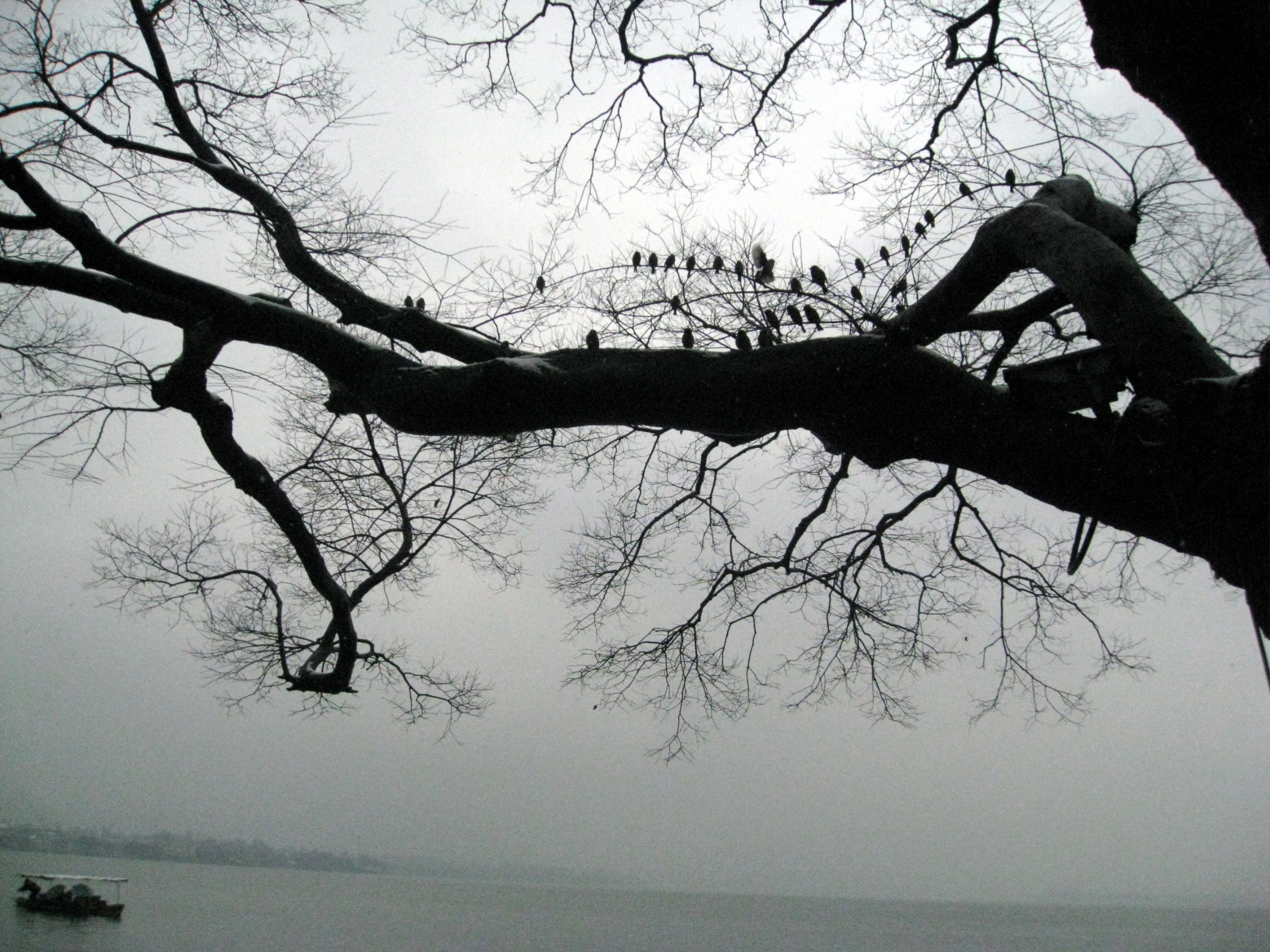
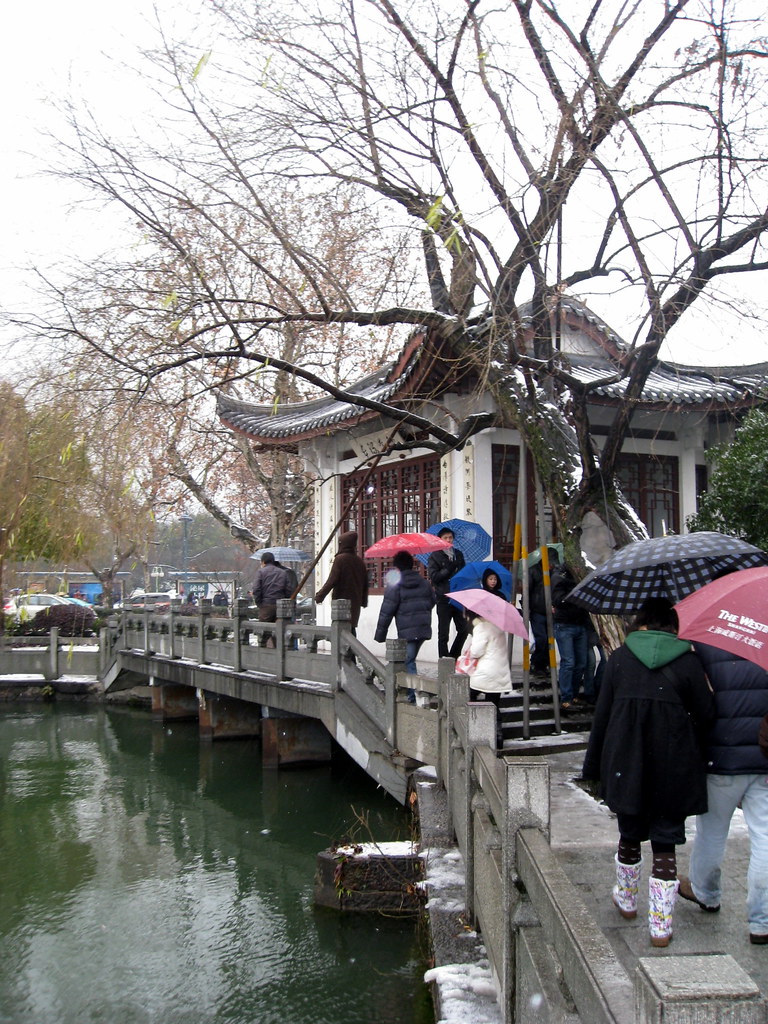
Hangzhou’s claim to fame is its lake called West Lake. It is surrounded on three sides by hills with little islands that dot the lake. This would’ve been a great destination in the summer time, a great place to rent a bike and ride it around the lake. On the day we visited it was snowing in Hangzhou, and according to our tour guides from the office, this is the first time they’ve ever witnessed snow in this part of China.

It took us about three hours to get here from Shanghai because of the traffic – there was a lot of snow and ice on the road, making it hard to maneuver the roads. We arrived just in time for lunch at a lovely restaurant overlooking West Lake. As is the custom here in Shanghai, one person orders for the entire table lots of different dishes and everyone in the table gets to try all of them. We had tons to eat – bamboo soup, duck, beggar chicken, dried anchovies, shrimp with tea leaves, fried bean curd, steamed fish, and for dessert a sweet hot soup from made from fermented rice balls and sticky purple rice. All the dishes tasted great! To make up for all the food we ate, we took a leisurely stroll around part of West Lake and took some amazing pictures.

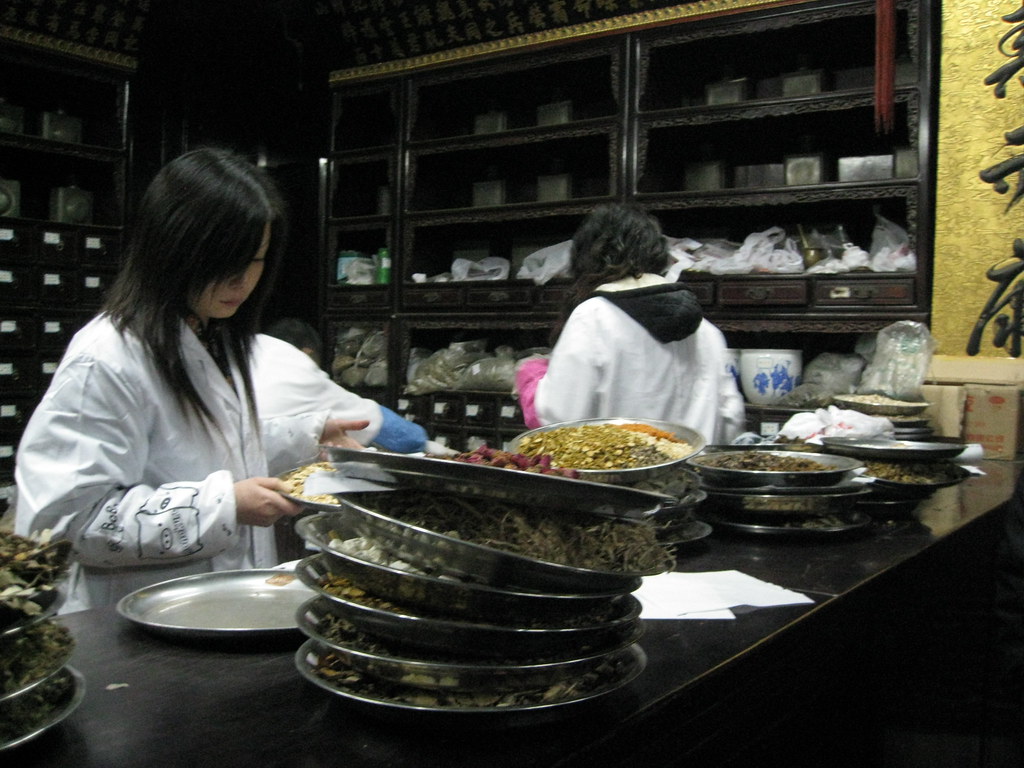
After finishing our walk, we headed to a traditional Chinese pharmacy, which was adjoined to the Medicine Museum in Hangzhou. The pharmacy was not unlike the ones we have in the US in terms of service provided but the medicines they gave out were made from plant extracts and crushed bone. Some ingredients were very commonplace like rose buds (I don’t know what it was used for though) and some were very exotic, like snow leopard bone or rhino horn. I didn’t see any of these exotic things on the counter but I imagine that these would be very expensive and hard to come by.

We entered the museum through the back of the pharmacy. The museum provided a brief history of Chinese medicine from its beginnings to today, but honestly I wasn’t paying much attention. I was too busy looking at all of the exotic animals they hunted (and maybe still do) for these medicines. They include tigers, rhinos, bears, leopards, and eagles. It was widely believed the ingesting bone or parts of these animals meant that you captured the essence of the animal, but being an animal lover I really don’t believe this to be the case. Still, it was interesting getting a glimpse of that world.

After the museum we made the long drive back to Shanghai, which also took three hours. By the time I got home I was exhausted and got into bed after a nice warm shower.

More pictures here.

Sunday, January 27, 2008

Things to do on a rainy weekend

It’s not all about work here in Shanghai. I do get plenty of opportunities to catch my breath and relax, and when that happens I don’t want to do anything. During my downtime I am usually slumped in my sofa here at the hotel, watching TV or reading books, or else catching up on precious sleep. What’s more, the internet connection is excruciatingly slow and posting pictures and blogging has become an exercise in patience. Two weeks late (but better late than never), here is a recap of what I did during my first weekend here in Shanghai.

Saturday
The rain ruined our plans to visit Hangzhou for the weekend, so my boss Claudia and I decided to visit the Shanghai Museum instead. We thought that perhaps the rain would die down, and learning about Chinese culture while waiting it out was a good plan.

The museum was organized according to art materials: ceramics, bronze, jade, textiles, furniture, etc. There were some very lovely things on exhibit in the museum but one couldn’t help wondering why a country with such a rich and varied history as China wouldn’t have more art to showcase. Someone at the office explained that a lot of art was destroyed during the Cultural Revolution, and some were smuggled out of the country. It’s a shame really, because a lot could be learned by future generations from beautiful Chinese artistry. After approximately three hours in the museum (with a tea break after an hour and a half of walking around with an audio guide glued to our ears), we decided to call it a day. That’s when Prime Minister Gordon Brown walked into the museum, with about 100 people trailing him and crowding the escalators. We watched him ascend all the way up to the fourth floor before heading outside, and once there we were stopped by security and told to wait in the rain until he left. Apparently it was a big security concern to walk to the other side of the street despite fact that Mr. Brown was still in the museum. I don’t understand how that impacts his safety, but whatever – I did what I was told.

After visiting the museum, we visited the shopping center next door called the D Hong Kong mall. The mall is located inside an old bomb shelter, built in the days of the Cold War, and you could tell that it was indeed a bomb shelter by the low ceilings and poor lighting. The shopping wasn’t great but the location was worth a visit. The place was quite big, and you couldn’t help but wonder how many people they planned to stick in there when it was built.

Pictures are here.

Sunday
Again, it was raining. Claudia, having had enough after walking home the night before (there were no taxis so we had to walk back to our hotel room), decided that she was going to stay in and rest during the day. I wasn’t thrilled with the idea spending a day at the hotel so I decided to take a walking tour of the Bund. The Bund is the business area here in Shanghai situated on the banks of the Hangpu River. There’s a nice promenade that stretches that showcases the buildings and history of Shanghai. I made the most of it by passing some landmarks and taking pictures of Pudong (still a part of Shanghai) across the river. I came home shortly thereafter and drank plenty of hot tea to warm me up again. I wouldn’t normally insist on talking a walking tour of anything during the rain, but there were other people there as well taking in the sights despite the horrible weather.

Pictures are here.

Thursday, January 24, 2008

Grateful for the Little Things

I typically work harder when I’m working internationally. It’s not that the work itself is harder; it’s that there is more to do in a small amount of time. Long work days are the rule and not the exception.

That being said, traveling to a foreign country also has its perks. The one perk I am enjoying during my stay here is my junior suite at the Westin. I’m sure I’ve mentioned it before, but I'd like to share my favorite things about my room:


This is called a rainforest shower head. When standing under it, it feels like taking a warm shower from a waterfall (apparently that is how people living in the rainforest take showers). Not a second is spent waiting for the warm water to envelop your body, and it is especially relaxing when taking a shower at night.


This bathtub is huge. Plus there’s ample room on the side to hold books and magazines while enjoying a soak in the tub.


Every pillow has a different consistency – some are firm, some are soft, and some are stuffed with feathers. I like the ones stuffed with feathers. The hotel also has a turn-down service where they close the curtains and pull down the bedding corner for you, like shown above. The only thing missing is the chocolate.


This is a magical device. It turns the lights in the living room, bathroom, and bedroom on and off and is conveniently placed on the nightstand. It’s especially helpful when you are suffering from jet lag and are desperate for sleep.


Room service - need I say more? Tonight I had seafood yellow curry with oatmeal cookies and warm milk for dinner. I think I've gained at least five pounds during this trip!

Even though I work some crazy hours, it’s nice to know that at the end of the day I come home to these things. It tempers the sting of hard days and makes the end of the day so much more rewarding.

Thursday, January 17, 2008

Lookin' for Love in Shanghai

Shanghai is everything I thought it would be and nothing what I thought it would be. If that statement made you say “huh?!” please allow me to explain.

Shanghai is full of contradictions, and everyday I learn something new about the city, the culture, and the people. Apparently Shanghai is very different from the rest of China – it’s cosmopolitan and modern, which is reflected not only the city’s high-rise buildings but in its attitude as well. I’ve been told that most of China is very rural and simple, and finding someone who speaks English is highly unlikely (but not impossible).

I’ve been visiting warehouses and distribution facilities located an hour out of the city for the past three days (hence the lack of posts), and it is during these excursions that I’ve learned the most about Shanghainese culture. I met a girl named Jessica who had the task of translating my conversations with the warehouse staff. The warehouse staff had lunch brought in for us during both days, and while we ate lunch we had some time to chat about cultural differences between the US and China. Did I mention we ate KFC on Wednesday and Pizza Hut on Thursday? If the Chinese keep eating like this they might beat us as the fattest nation on earth soon.

I learned from Jessica that Shanghainese women are determined to make good use of their education and excel in their career but also have a strong desire to find a suitable husband. For Shanghainese women in particular, it is hard to find a husband who is as successful in their career and have the same family and educational background as the women. It’s very important to have an equal partnership so that family, education, career, and salary are carefully matched for an ideal marriage. For Jessica, good men are hard to find, especially with such vivacious females here in Shanghai.

I asked Jessica how one would find a husband, and she said that the most common method was to have blind dates set up by the man and woman’s parents. The parents would meet and discuss their offspring: where they graduated, their salaries, their interests, their goals, etc. If they found a good match, two would meet at a local tea house and get to know one another. If the date went well, they’d see each other again; if not, it was up to the parents to set up another blind date. To me, this sounds like an episode of the show Parental Control in MTV without the sound bites. Anyway, Jessica just had a blind date recently, and she said that it did not go well. Her date was too quiet for her and she wanted to find someone who could equal her conversation skills (which is a tall order because this girl talks A LOT). Jessica’s goal this year is to find a husband, and since she was born in the year of the Rat (which is the animal for this year’s Chinese New Year) she might get lucky this year.

Jessica also told me that ladies here in Shanghai love Starbucks coffee, Haagen-Dazs ice cream, and Louis Vuitton purses. She said that if men want to cheer up their girlfriends or wives, they take them to Haagen-Dazs for an ice cream treat. She also said that an appropriate gift for a 30-year wedding anniversary was a Louis Vuitton bag – sure, you can tell your wife that you love her, but giving her a Louis Vuitton bag proves it. I cannot make this up!

Louis Vuitton must be dancing in his grave.

Monday, January 14, 2008

Welcome to China

Flying to Shanghai
The flight to Shanghai went well. There was a little bit of turbulence on the way over but nothing crazy, just a few bumps here and there. Of course, I didn’t sleep on the plane until the last three hours before landing, which is an awful time to want to sleep because of everything happening around you. This is when the last meal is served and everyone is waking up and going to the bathroom, or organizing their stuff, or starting to get chatty with their neighbors. The passengers behind me were very chatty, and despite using the airline-supplied ear plugs and attempts to cover my ears with the tiny pillow, it was impossible for me to sleep.

Arrival
The arrival process at the airport was a breeze – my boss Claudia and I went through immigration, collected baggage, changed cash, and passed through customs in about 30 minutes. The efficiency surprised me, considering there were so many passengers on my flight. We had a driver meet us at the airport and we got to our hotel about an hour. It was raining the night we arrived in Shanghai, which was Sunday, and there wasn’t a lot of traffic on the roads.

Hotel

The Westin Bund Hotel was very nice, with a newly renovated tower and front entrance. Since I was going to be in town for the next three weeks, I was upgraded me to a junior suite, and now I have a living room-slash-office to call my own. The room also came with a master bath the size of my living room at home, which had two entrances like Carrie Bradshaw’s bathroom in Sex & the City: one right by the door as you enter the room, and one by the bedroom area. It’s a good idea, really, because after a long day at work the first place you want to visit is the bathroom before you crash into bed.

16 Hours Ahead
It’s been tough transitioning to the time difference, which is 16 hours ahead of my usual time. Right now it’s 5:38 am on Tuesday but I’m wide awake. I’ll probably crash a little bit around 4 pm, and recover in time for dinner. It’ll be like this for the first few days, and by next week I should be fully acclimated to the time here in China.

There will be more posts to come, hopefully more interesting than this one. My first day of work was tough, and the next few days will be no different. And the internet connection here at the hotel? It's really slow. It takes 10x as long to surf the net, never mind posting pictures at this blog. Click on the Flickr link above to see my first pictures of Shanghai.